


José María Sanz de Galdeano Equiza and Ángel Llamazares Álvarez participated in a session at Ataria dedicated to risk management, institutional collaboration, and the challenges of the urban water cycle.


1926 – 2026
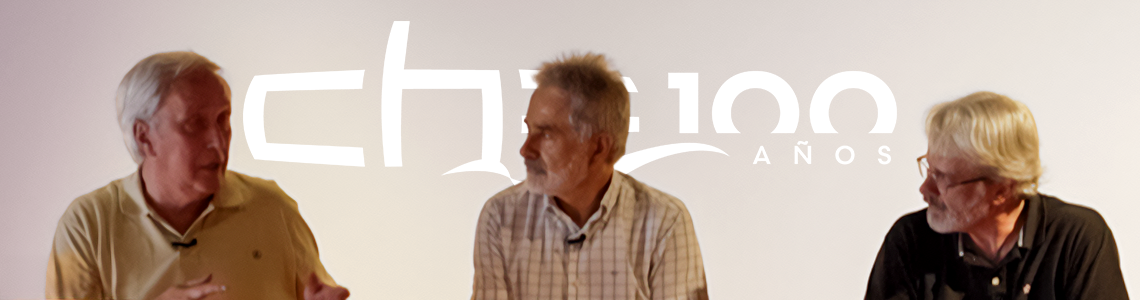
José María Sanz de Galdeano Equiza and Ángel Llamazares Álvarez participated in a session at Ataria dedicated to risk management, institutional collaboration, and the challenges of the urban water cycle.
18/06/2026
Vitoria-Gasteiz hosted a new session of the Centenary Meetings of the Confederación Hidrográfica del Ebro on Thursday, June 18. The event, held at Ataria and presented by Javier San Román, Deputy Water Commissioner of the CHE and Centenary Commissioner, brought together two complementary perspectives on water management in Álava and its future challenges.
José María Sanz de Galdeano Equiza, Director of Planning and Works at the Basque Water Agency (URA), focused his presentation on the Zadorra system, flood risk management, and inter-administrative cooperation. Ángel Llamazares Álvarez, former manager of AMVISA, reviewed the institutional collaboration that has improved water supply and sanitation in Vitoria-Gasteiz, and outlined some of the pending challenges for advancing towards more integrated water management in the territory.
Sanz de Galdeano reviewed the main milestones that have marked water management in Álava since the creation of the river basin authorities in 1926 and the construction of the Zadorra reservoirs in the late 1950s. His account particularly highlighted the 1989-1991 drought, an episode that tested the water supply of Vitoria-Gasteiz and Bilbao and spurred a dialogue process among territories, users, and managers.
From 1997, the CHE promoted a joint work process to improve network efficiency, increase capacity, strengthen the security of the Zadorra, and agree on reservoir operating rules. The February 2003 episode reinforced the advisability of moving in that direction. The process culminated in the so-called “Peace of Ullibarri”, the agreement reached in 2008 and ratified by the CHE in 2009, which established guarantee, discharge, and safeguard curves and continues to be a reference for coordinated system management.
The presentation emphasized that risk reduction does not depend on a single work or decision, but on coordination among water management, land-use planning, and emergency response. This approach is materialized in four lines of action: prevention, protection, preparation, and recovery.
Among the advances presented were the regulation of uses in flood-prone areas, risk management plans, coordination between URA and Civil Protection, and the UHATE hydrological prediction system, integrated with alert systems and CHE tools. Dynamic reservoir management allows for flood attenuation and reduction of their effects, and must be complemented by territorial planning and self-protection, especially in areas of the Zadorra basin that are outside reservoir regulation.
Sanz de Galdeano also highlighted actions aimed at “giving space back to the river”, reducing flood risk, and restoring the natural dynamics of watercourses. Projects developed in the Zadorra, Abetxuko, and the Batán and Zapardiel rivers demonstrate how flood protection can be combined with environmental improvement and adaptation to climate change.
Ángel Llamazares began his account in 1973, when Vitoria-Gasteiz faced significant needs for improvement in water supply, consumption was around 650 liters per inhabitant per day, and only 29% of the water was controlled. Five decades later, consumption has been reduced to less than 200 liters and controlled water exceeds 84%, while the city has an extensive sanitation network.
The transformation was possible, he explained, thanks to cooperation among the City Council, AMVISA, the CHE, the Basque Government, and other organizations. This collaboration made basic water supply and sanitation infrastructures possible, from the Ullibarri intake and pumping to the Araka treatment plant, the head and tail reservoirs, the wastewater collector, and the Crispijana treatment plant.
Llamazares also reviewed the coordinated response to the late 1980s drought, the 2008 reservoir management agreement, and the Zadorra Reservoir Monitoring Board, which brought together hydraulic administrations, emergency services, operators, and the City Council in complex situations. He also mentioned URA and AMVISA’s actions to strengthen supply security and the AKUAL program for water and sanitation cooperation between the Basque Country and Central America.
Looking ahead, Llamazares pointed out the need to update the infrastructures planned for prolonged water scarcity episodes and to address the debate on integrated water management in Álava. His proposal involves a major institutional agreement that allows progress towards a public manager with sufficient technical and economic capacity, equal rights and obligations for users, and participation of territorial institutions and URA.
Both presentations converged on a central idea: the most significant advances of recent decades have occurred when administrations, operators, and emergency services have shared information, resources, and responsibilities. The session concluded with a dialogue with the public on reservoir management, flood management, scarcity periods, and the governance model needed to face the next centenary.
The Vitoria-Gasteiz event continues the sessions held in Reinosa, Miranda de Ebro, and Logroño, as part of a program that brings the history, experience, and challenges of water management in the Ebro basin closer to the public.