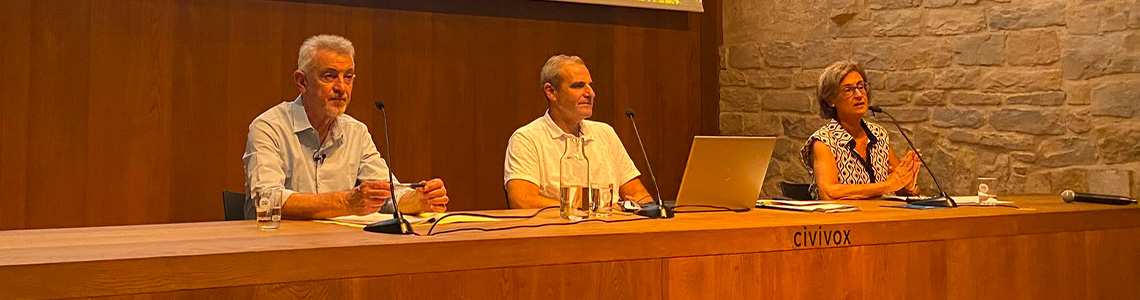
Pamplona hosted a new session of the Centennial Meetings of the Confederación Hidrográfica del Ebro on Thursday, July 30. The event, held at el palacio del Condestable and presented by Marisa Moreno Santaengracia, Head of the Hydrology and Watercourses Area at Confederación Hidrográfica Ebro, discussed the relationship between people and towns with rivers from two very different perspectives.
Luis Sanz Azcárate, PhD in Biology and director of the water area at OREKAN – Gestión Ambiental de Navarra, a public environmental company of the Government of Navarra where he has worked for more than 20 years. He spoke about water management in Navarra, focusing on flood risk management, both in terms of its administration and the adaptation and recovery of riverbeds to minimize its effects. He also highlighted the importance and good results of cooperation between institutions.
The connection of cultures through rivers
José Antonio Perales Díaz, PhD in Social and Cultural Anthropology from the Autonomous University of Madrid and collaborating professor at the Public University of Navarra. He spoke about the cultural heritage surrounding rivers in Navarra, and specifically about bridges as elements connecting territories, cultures, and memory, and their symbolic role within communities. His presentation concluded with a tour of the traditional mills of Navarra, as centers of traditional economic production exploiting water resources, around which life developed.
Different perspectives of the same reality
Attendees at the Meeting were able to contrast two different but converging viewpoints on the relationship between people and societies with rivers and their valleys. Luis Sanz’s technical vision focused on how rivers have been managed to try to minimize the effects of floods over time. The developmentalism of the 20th century led to the construction of homes and other infrastructure in areas traditionally avoided due to flood risk. Old settlements are built in safe areas, while new neighborhoods have colonized less safe areas. On the other hand, the attempt to restrictively control riverbeds through embankments and other resources caused other problems in the event of major floods. Current actions to restore riverbeds, eliminate barriers, and return space to rivers are helping to restore balance and implement strategies to minimize flood damage caused by high waters.
José Antonio Perales provided a historical perspective on the relationship with rivers and their management through infrastructures such as bridges, which connect riverbanks and therefore the towns on each side, but which are also elements that tell us about the culture, thought, and way of life of the people who built them. Other constructions, such as mills, have had a function of economic and social development, using water as a driving force to power machines that ground grain or fulled fabrics. Technology changes, but issues surrounding rivers remain over time, and each society has had to manage them with the tools and criteria of its era.
The Cycle Continues Through the Ebro Basin
The Pamplona edition continues the sessions held in Reinosa, Miranda de Ebro, Logroño, and Vitoria-Gasteiz, as part of a program that brings the history, experience, and challenges of water management in the Ebro basin closer to the public. The next event will be on October 1 in Lleida.