Alfredo Ollero Ojeda and Pablo de la Cal Nicolás participated in a session at the Casa de las Ciencias dedicated to the middle Ebro, river restoration, flood risk management, and new city models in the face of climate change.


1926 – 2026
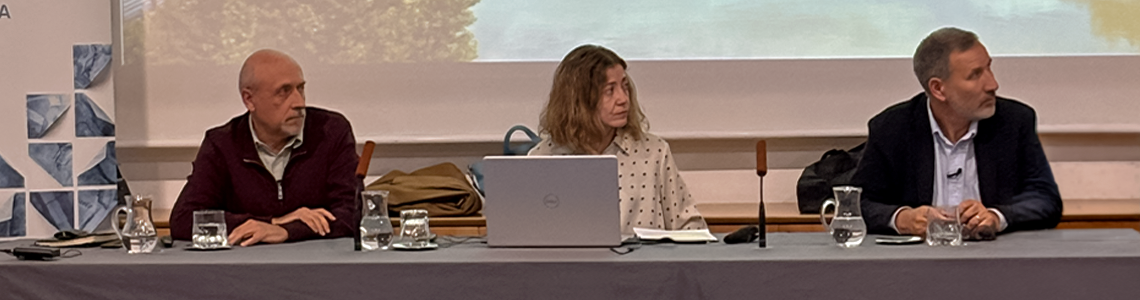
Alfredo Ollero Ojeda and Pablo de la Cal Nicolás participated in a session at the Casa de las Ciencias dedicated to the middle Ebro, river restoration, flood risk management, and new city models in the face of climate change.
14/05/2026
Before the session, Alfredo Ollero Ojeda was interviewed by Cecilia Romero on Más de uno La Rioja, on Onda Cero La Rioja. During the conversation, he previewed some of the ideas he would develop that afternoon at the Casa de las Ciencias, as part of The Centenary Encounters. Listen to the full interview on Onda Cero.
The Casa de las Ciencias de Logroño hosted a new session of the Centenary Encounters in Logroño of the Confederación Hidrográfica del Ebro, organized around a shared question: how to live with the river, how to care for it, and how to adapt its management to current environmental challenges.
The meeting was held as part of the CHE centenary activities and within the framework of the exhibition Through the Ebro Basin, which can be visited at the Casa de las Ciencias until May 31.
The session was introduced by Miriam Pardos, Water Commissioner of the CHE, who highlighted the complementarity of the two perspectives presented: hydromorphology and river restoration, on one hand, and the relationship between river and city, on the other. The speakers were Alfredo Ollero Ojeda, professor and researcher at the Universidad de Zaragoza specializing in physical geography, fluvial geomorphology, flood risk, and river restoration, and Pablo de la Cal Nicolás, PhD in Architecture and Professor of Urbanism and Territorial Planning at the Universidad de Zaragoza.
Ollero opened his speech with a central idea: restoring a river does not mean trying to return to an impossible historical image, but rather helping the fluvial system build a more functional future. His presentation, titled “River Restoration and Hydromorphology in the Ebro Basin“, explained how rivers function from a hydromorphological perspective and why this interpretation is essential for better risk management and recovering the health of riverbeds.
The geographer reminded the audience that a river does not only transport water. It also moves sediment, nutrients, organic matter, wood, and living beings. This transport is organized through processes of erosion, transport, and sedimentation, and is especially activated during floods, which size the channel, mobilize materials, nourish riverbanks, and allow the river to adjust. For this reason, he argued, floods should not be understood solely as a threat: they are part of the river’s natural functioning and its capacity for self-regulation.
In the case of the Ebro, Ollero placed fluvial deterioration within a trajectory marked by regulation, defenses, channelization, dredging, the occupation of floodplains, and the loss of sediment. The combination of climate change, global change in basins, reservoirs, and certain poor local practices is favoring narrower, simpler, and more incised channels. This simplification reduces geomorphological and ecological diversity and increases vulnerability to extreme events.
According to Ollero, river restoration must be primarily hydromorphological: eliminating impacts, rebuilding the fluvial structure, and letting the river work. This requires water, sediment, floods, space, and time, in addition to an educated society that is aware of fluvial processes.
The speaker insisted that not every green intervention is restoration. Stabilizing banks, landscaping riverfronts, or planting vegetation in active channels may be a landscape improvement or even a counterproductive intervention, but it is not necessarily equivalent to restoring a river. Real restoration involves returning space, recovering longitudinal, lateral, and vertical connectivity, reconnecting channels, banks, floodplains, and aquifers, providing sediment when necessary, and removing obsolete obstacles.
Ollero linked this vision to the European Nature Restoration Law, approved in 2024, which proposes the recovery of free-flowing rivers and the removal of barriers that interrupt fluvial connectivity. In the same vein, he placed the removal of dams, weirs, fords, and defenses, the setting back of levees, the recovery of secondary branches, and the permeabilization of floodable areas.
During the presentation, examples of restoration and risk management in different areas were presented. Ollero referred to actions in the middle Ebro linked to Ebro Resilience, such as levee setbacks and the recovery of fluvial space in sections of Alfaro, Castejón, or Alcalá de Ebro. In the latter case, he highlighted the role of the relief channel, which during a small flood managed to divert a significant part of the flow and reduce speeds near the town, combining the recovery of fluvial dynamics and risk reduction.
He also explained the project for the Huerva River in Zaragoza, where sediment and flows capable of mobilizing them have been added to rebuild the bed in incised sections. He also cited obstacle removal actions in other rivers, fish passes when removal is not possible, and open conflicts such as the one at the La Retorna weir in the Najerilla, which show the need for social dialogue in restoration.
Ollero’s conclusion was clear: 20th-century solutions, based on containment and narrowing, are not enough for 21st-century challenges. Levees do not always protect; they often disconnect the river from its plains and prolong damage. Safety must also be supported by reducing exposure and vulnerability, recovering functional floodplains, and building a risk culture that understands floods as necessary processes.
The second intervention, “Renaturalization in the City: Limits and Desires”, moved the debate to the urban sphere. Pablo de la Cal started from an idea complementary to Ollero’s: if the river is an altered natural system, the city is a built artifact that also needs to be transformed to adapt to climate change.
De la Cal explained that European cities have developed for centuries from an opposition between city and countryside, between the built and the natural. Faced with this heritage, contemporary urbanism is strongly incorporating green and blue infrastructure: networks of parks, riverbanks, permeable soils, wetlands, ecological corridors, trees, peri-urban spaces, and sustainable drainage systems that provide ecosystem services.
In this new generation of urban plans, he noted, three elements take on central importance: soil, water, and vegetation. Renaturalization does not consist only of adding green, but of allowing natural processes to occur within the city: retaining rainwater, favoring evapotranspiration, creating permeable surfaces, reducing the heat island effect, improving biodiversity and urban health, and making these processes visible in public space.
The architect reviewed European and Spanish references, from urban climate change adaptation strategies in the Netherlands to the superblocks and green axes of Barcelona, or the Green and Blue Infrastructure Plan of Pamplona. These examples show that every street, square, roof, park, or riverbank can be part of a broader urban strategy rather than isolated actions.
In the case of Zaragoza, De la Cal recalled the process that led to the transformation of the Ebro riverbanks for the Expo 2008 and its background in the debate “Rivers and Cities: Contributions for the Recovery of the Rivers and Riverbanks of Zaragoza“. He acknowledged that Zaragoza had constrained the Ebro significantly, but explained that that period allowed for thinking about the city on a large scale: the Water Park, the green ring, connections with the Imperial Canal, the Huerva and Gállego rivers, and the recovery of irrigation ditches as potential water corridors and public spaces.
De la Cal noted that Zaragoza then looked with interest at cities like Logroño and Lleida, which already had fluvial parks integrated into urban life. In Logroño, this reference allows the Ebro Park and the riverbanks to be seen as spaces for coexistence between citizen use, fluvial landscape, and risk management.
Urban renaturalization, De la Cal warned, enjoys broad initial consensus but faces practical limits: costs, maintenance, administrative inertia, individual discomfort with the presence of nature, and the risk of interventions remaining as showcase spaces. Therefore, he called for long-term planning, integration with general planning, mobility, and other urban instruments, and public management capable of sustaining the transformation over time.
The colloquium reinforced this idea. Reflecting on Logroño and Zaragoza, De la Cal argued that moments without great urban pressure are precisely the best times to think, draw, communicate, and reach consensus. Decisions regarding the relationship between city and river are not improvised when the flood arrives.
Ollero, for his part, highlighted that Logroño has treated the river better than many other cities and pointed out the potential of spaces like El Sotillo to continue being naturalized. He also insisted on the importance of peri-urban sections, which are often more degraded than central ones and are increasingly used by citizens for walking, cycling, or getting closer to nature.
The session ended by looking to the future. Asked how to imagine the Ebro basin in 2050, Ollero proposed a horizon with greater fluvial naturalness: recovering connectivity, improving sediment transport, and allowing the river to rebalance its banks and islands wherever possible. De la Cal avoided making specific proposals but imagined shadier cities with mature trees, less dependence on private vehicles, and a use of public space more compatible with urban health and comfort.
The shared message of the day was that rivers and cities can no longer be thought of separately. River restoration and urban renaturalization require science, planning, risk management, social participation, and a new territorial culture. Returning space to the river and making room for nature in the city are not decorative gestures: they are conditions for better adapting to climate change and living more safely with the Ebro.