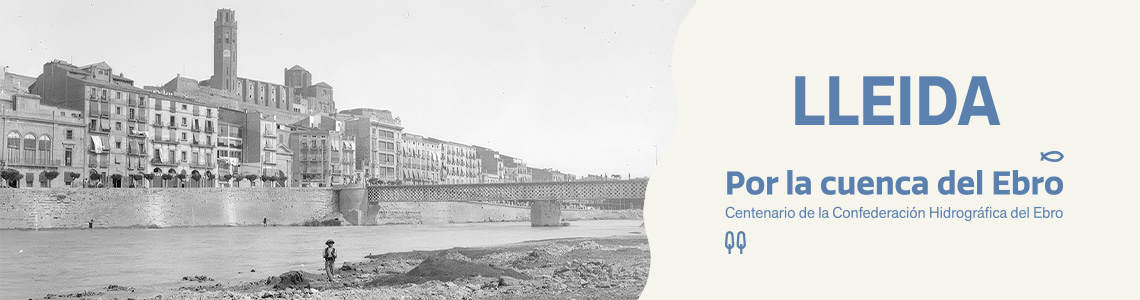
The Museu de Lleida hosts, from September 17 to October 18, the exhibition “Through the Ebro Basin. Centenary of the Confederación Hidrográfica del Ebro,” a traveling exhibition that looks back on the hundred-year history of the CHE and its work in water management in the Ebro basin.
The inauguration, held in the plaza of the Museu de Lleida, featured remarks by Clara Arbués Garcia, director of the Museu de Lleida; Pilar Bosch Vilana, councilor for Culture, City Promotion, and Consumer Affairs of the Lleida City Council; and Javier San Román Saldaña, deputy commissioner of Water of the Confederación Hidrográfica del Ebro and commissioner of the Centenary. Following the remarks, a guided tour of the exhibition was held.
Organized by the Confederación Hidrográfica del Ebro and the Museu de Lleida, with the collaboration of the Museu de l’Aigua de Lleida, the exhibition presents the natural, territorial, historical, and cultural diversity of the basin, as well as the evolution of its management over the course of a century. The proposal combines historical documentation, hydraulic heritage, objects, photographs, and audiovisual and interactive resources.
Lleida and the Segre, protagonists of the local section
The arrival of the exhibition in Lleida incorporates a specific section dedicated to the historical relationship between the city and the Segre River. The exhibition explains how the development of Lleida has been closely linked to the proximity of water and how the different uses of the river—human consumption, irrigation, industry, and motive power—have shaped the evolution of the territory since antiquity.
This relationship is also made visible through the network of canals that has historically articulated the Lleida territory, from the medieval canals of Pinyana and Fontanet to the great modern irrigation systems of Urgell, Aragón y Cataluña, and Segarra-Garrigues.
Among the elements that form part of this local section are various objects and documents related to the history of water in Ponent. Notable among them are a waterwheel bucket from the 13th–14th centuries from an archaeological intervention on Calle Major in Lleida, on loan for the occasion from the Arxiu Arqueològic; a facsimile of the Segre channeling project prepared by Manuel Lorenzo Pardo in 1909, from the CHE archive; some objects from the collection of the Museu de Lleida itself; as well as documentation and images linked to the canals, mills, and major hydraulic infrastructure of the territory.
The Great Agricultural Exhibition of Lleida of 1928
One of the highlights of the exhibition is the Great Exhibition of Lleida of 1928, held at the Camps Elisis and organized by the Confederación Sindical Hidrográfica del Ebro. The exhibition brought together agricultural machinery and content related to rural health and became one of the most significant events in Lleida in the first third of the 20th century. The event served as a great commercial stimulus and was a direct antecedent of the subsequent consolidation of the Fira de Sant Miquel.
The exhibition makes it possible to recover this episode and relate it to the importance that agriculture, irrigation, and water management have had in the economic and territorial development of Lleida.
Notable is the screening of a 1928 film, “Great Exhibition of Agricultural Machinery and Rural Health,” by Antoni de Pàdua Tramullas, property of the CHE archive.
One hundred years of Ebro basin management
Beyond the Lleida section, “Through the Ebro Basin” offers a global view of the most extensive river basin in the State, articulated around the Ebro and its tributaries, among which is the Segre. The exhibition looks back on the evolution of water management during the hundred years of the CHE’s existence and highlights the documentary, technical, architectural, and artistic heritage generated during this period.
The exhibition also incorporates resources to bring current issues related to water and land management closer to the public, as well as an abridged version, 12 minutes and 48 seconds long, of the Centenary documentary “Through the Ebro Basin,” produced in 2025 by Al Este Films and Virtual&Civán.
With this stop in Lleida, the exhibition “Through the Ebro Basin” continues its commemorative journey through the territory and invites visitors to learn about the history of the Confederación Hidrográfica del Ebro through the relationship between water, heritage, and the societies that have lived in the basin.
The exhibition has been open to the public since today, September 17, and may be visited at the Museu de Lleida until October 18, 2026.
About the CHE
The Confederación Hidrográfica del Ebro (CHE) is an inter-community basin authority, attached to the Ministerio para la Transición Ecológica y el Reto Demográfico. Its functions include the construction and maintenance of infrastructures (dams and canals), maintenance and management of the agency’s assets, hydrological planning, administration of the public water domain, and coordination with sectors linked to its various uses and with administrations, with the aim of ensuring sustainable management in the Ebro basin, the largest in Spain. Since its creation, it has worked to balance technical management with environmental protection and public interest with territorial dialogue.
About the Centenary
The Confederación Hidrográfica del Ebro (CHE) was established under the name Confederación Sindical Hidrográfica del Ebro, created on March 5, 1926, and made official the following day in the Gaceta de Madrid. That project, in which engineer Manuel Lorenzo Pardo played a decisive role, introduced to Spain the idea of managing water under the principle of basin unity, transcending administrative boundaries and advocating for comprehensive planning. A century later, its centenary offers the opportunity to revisit that origin and bring the evolution of water management in the Ebro closer to the public. The commemorative program invites people to learn about this legacy and participate in it.