


The president of the CHE, Carlos Arrazola, and the Water Commissioner, Miriam Pardos, presented the book in a discussion with the journalist Marina Fortuño and the architect Sergio Sebastián.


1926 – 2026
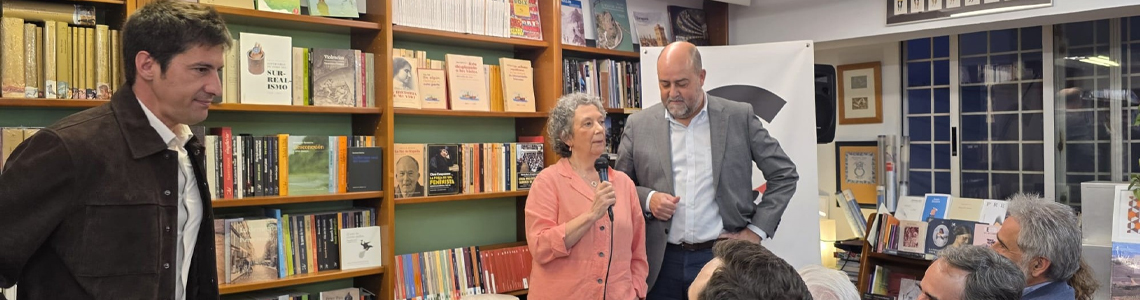
The president of the CHE, Carlos Arrazola, and the Water Commissioner, Miriam Pardos, presented the book in a discussion with the journalist Marina Fortuño and the architect Sergio Sebastián.
23/03/2026
Cálamo Bookshop in Zaragoza was the venue chosen by the Confederación Hidrográfica del Ebro (CHE), an autonomous body of the Ministerio para la Transición Ecológica y el Reto Demográfico (MITECO), to present its centenary book, “Along the Ebro Basin. 1926–2026 Centenary of the Confederación Hidrográfica del Ebro”, in a discussion between the Water Commissioner, Miriam Pardos, and the architect Sergio Sebastián, with the journalist Marina Fortuño. The event was closed by the president of the basin authority, Carlos Arrazola.
The president of the CHE wished to thank the work “of all the authors because the quality of the articles is outstanding. I also wanted to thank Cálamo for the venue, which, given the path it is on, I think will also reach 100 years”.
The moderator, Marina Fortuño, asked him about the importance of planning and order over these 100 years, a question on which Arrazola elaborated: “Planning based on participation, transparency and the common good. I believe that is what enriches the Confederación: coexistence among users, guaranteeing uses, keeping infrastructure in perfect condition, and pursuing good status for rivers.”
The president of the CHE highlighted the Confederación’s capacity to adapt. “I believe it is the fundamental value that has enabled us to reach 100 years,” he noted.
For her part, the Water Commissioner, Miriam Pardos, recalled that “when we began to think about how to celebrate the centenary, the idea of the book and of having people from outside the organisation explain how they saw the Confederación was an idea we immediately saw as clearly right.”
Marina Fortuño asked her specifically about the history of the Water Commissionership, which “is curious because in 1985 it was incorporated into the Confederación itself.”
“Yes, many times we civil servants ourselves are unaware of how the entire process of the Confederación’s evolution unfolded. Certainly, an important milestone was when the Commissionership was incorporated into the confederations, because that is when the current water legislation and the whole water-quality component emerged. In this way, it is no longer only about the use of the resource and ensuring that water is available for different uses—although this is an important objective in itself—but the whole aspect of caring for rivers is added,” explained the Water Commissioner. “At first, in 1985, the focus was only on the physicochemical quality of water. But in 2000 the Water Framework Directive appears, and then ecosystem quality is also recognised, the river as an ecosystem,” said Miriam Pardos.
Architect Sergio Sebastián leads the architecture studio that has rebuilt the former village of Ruesta, as well as two of the hermitages that form part of the Camino de Santiago—San Juan y Santiago de Ruesta and San Juan de Sigüés—which are located within the Yesa reservoir area and its area of influence. His presentation on the recovery of the CHE’s heritage was particularly moving.
News compiled and written based on the information published on chebro.es