


The exhibition Por la cuenca del Ebro opens at Ataria on June 12, 2026. An interview, one hundred years of hydraulic history, and a territory in Álava where water explains almost everything.


1926 – 2026
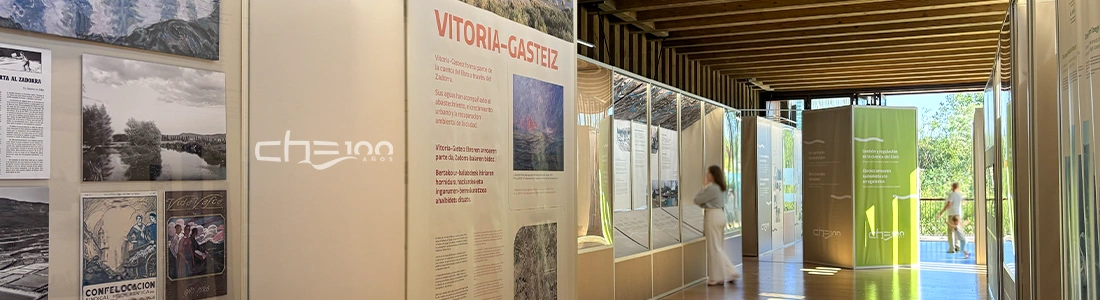
The exhibition Por la cuenca del Ebro opens at Ataria on June 12, 2026. An interview, one hundred years of hydraulic history, and a territory in Álava where water explains almost everything.
12/062026
The arrival of Por la cuenca del Ebro in Vitoria-Gasteiz has extended the public tour of the traveling exhibition for the Centenary of the Confederación Hidrográfica del Ebro. The exhibition, opened on Friday, June 12, at Ataria, the Salburua Wetlands Interpretation Centre, can be visited until July 12 and offers an educational journey through one hundred years of water management in the Ebro basin.
The Vitoria-Gasteiz City Council included the opening in its institutional agenda and Ataria presents the exhibition as a bilingual activity, with free admission until full capacity is reached, focusing on the natural, historical, and social dimensions of water. Coverage by Gasteiz Hoy focused on its local perspective: one hundred years of the Ebro in Álava, with special attention to the role of the Zadorra, the Salburua wetlands, and sustainable water management.
In this context, Radio Vitoria dedicated its June 12 interview to Javier San Román, Deputy Water Commissioner of the CHE and Centenary Commissioner. The conversation connects the opening at Ataria with issues very relevant to the citizens of Álava: the Ullibarri-Gamboa, Urrunaga, and Albina reservoirs, water quality, recreational uses, hydroelectric energy, and river restoration.
Thinking about water from the basin perspective
One of the core themes of the interview was the continued relevance of an idea that was innovative in 1926: managing water according to the natural boundaries of a river basin rather than administrative borders. San Román recalled that this vision, championed by Manuel Lorenzo Pardo, allows decisions to be made considering not just a specific point, but also those located downstream.
The conversation applied this general idea to everyday examples: flood management, water reserves during droughts, or discharge authorizations. In all cases, the basin unit appears as a form of coordination that requires considering the river system as a whole, its uses, and its cumulative effects.
The reservoirs of Álava: supply, energy, and leisure
San Román explained the relationship between the Ullibarri-Gamboa and Urrunaga reservoirs, which are connected by a tunnel and managed in coordination with Iberdrola, the infrastructure owner. Under ordinary conditions, they operate according to their exploitation rules, while during flood or drought episodes, the Confederación assumes a leadership and coordination role.
He also noted that the uses of these reservoirs have evolved. They were created with a clear hydroelectric purpose, but today they are essential for the water supply of Vitoria-Gasteiz and Bilbao, in addition to supporting recreational activities that are increasingly integrated into the social life of the territory.
The conversation also addressed water quality. San Román defended the value of tap water, treated in purification plants and subject to controls, and emphasized the environmental importance of consuming water from public systems over the massive use of bottled water.
Salburua as a symbolic place to talk about water
The choice of Ataria and Salburua as the venue for the exhibition reinforces the link between the display and the territory. Radio Vitoria concluded the interview by asking about the role of wetlands in relation to rivers. San Román defined them as spaces with regulatory and purifying capacities: places where water expands, levels out, and contributes to sustaining biodiversity.
After passing through Reinosa, Miranda de Ebro, and Logroño, the exhibition now stops in Vitoria-Gasteiz before continuing its itinerary through Pamplona, Huesca, Lleida, and Tortosa. In Álava, this relationship involves the Zadorra, the reservoirs, Salburua, and the daily experience of a city that lives with water as a resource, landscape, and natural infrastructure.
The opening on June 12 received institutional and media coverage. The Vitoria-Gasteiz City Council included it in its official agenda; Noticias de Álava, Gasteiz Hoy, and Diario Euskadi published pieces on the arrival of the exhibition in the Alavese territory.
Centenary Encounters at Ataria: June 18, 5:30 PM
The exhibition’s stay in Vitoria-Gasteiz includes a session of the Centenary Encounters. On June 18, at 5:30 PM at Ataria, two specialists will address water management in the Alavese territory: José María Sanz de Galdeano Equiza will present the evolution of the Zadorra system and its role in risk management; Ángel Llamazares Álvarez, from AMVISA, will explain how inter-institutional collaboration for managing urban water in Vitoria-Gasteiz is articulated in practice. The session is free to attend.