


A century later, water management relies on more science, more data, and more cooperation in a diverse and united basin.


1926 – 2026
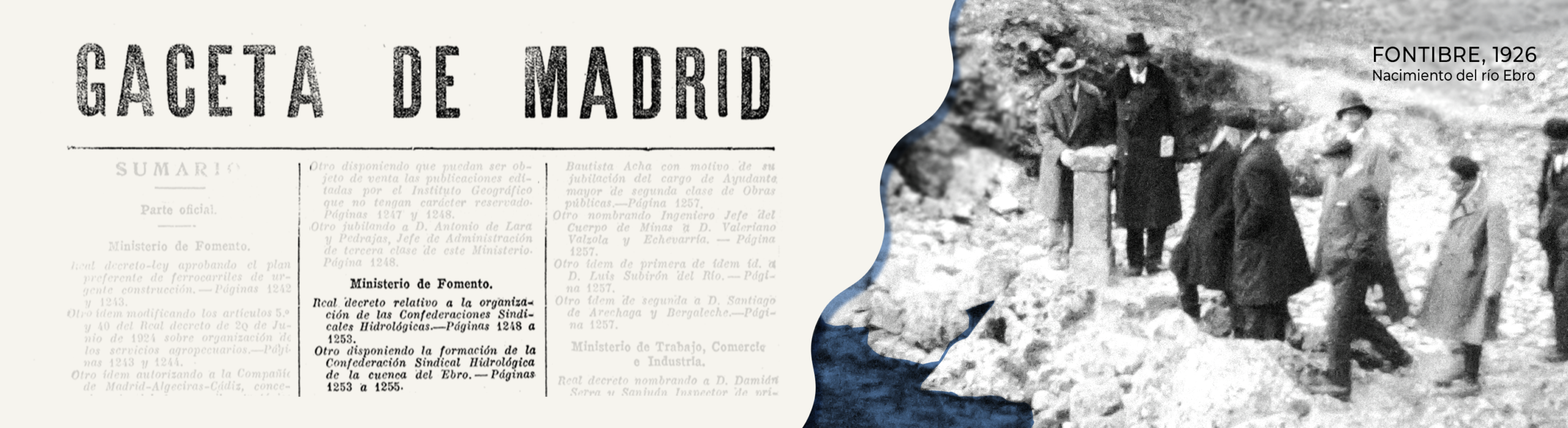
A century later, water management relies on more science, more data, and more cooperation in a diverse and united basin.
05/03/2026
One hundred years ago, a Royal Decree signed on March 5, 1926 promoted the creation of the Confederación Sindical Hidrográfica del Ebro, now the Confederación Hidrográfica del Ebro (CHE), and its publication the following day in the Gaceta de Madrid consolidated a model that introduced water management based on the river basin unit, disregarding administrative boundaries.
An initiative aligned with the regenerationist thinking of the time, which advocated modernizing the country through knowledge, planning, and hydraulic works oriented toward the common interest. In that context, the engineer Manuel Lorenzo Pardo promoted the creation of an organization to manage water with a comprehensive vision: the CHE.
Today the basin faces intense episodes of flooding and drought. Agricultural, urban, energy, industrial, and recreational uses coexist within it, along with the need to preserve ecosystems. The CHE addresses this through planning, public information, prevention, and coordination with administrations and sectors.
The Centenary focuses on that work: planning, management and protection of the public water domain, construction and maintenance of infrastructure, heritage management, and its direct impact on water supply, economic activity, flood prevention, and environmental status.
Activities are already underway. In December 2025, the first edition of the traveling exhibition Por la cuenca del Ebro was inaugurated in Reinosa, continuing in 2026 at various venues. The next will be Miranda de Ebro, with the opening scheduled for March 17. The exhibition incorporates adapted content to contextualize the territory’s relationship with water.
The traveling exhibition includes a condensed version of the Centenary documentary and audiovisual materials adapted to each venue. From October to January, the central exhibition will be shown at the Palacio de Sástago (Zaragoza), and also in October the central commemorative event will be held. The 2026 program also includes the publication of a book, the production of a documentary, and the organization of a series of meetings addressing topics such as water management, the culture of the Ebro territories, the environment, history, and economic activities around the rivers.
To follow the activities and access background information, the commemorative website offers a newsletter and a timeline with the main historical milestones.
About the CHE
The Confederación Hidrográfica del Ebro is an inter-community river basin authority, attached to the Ministerio para la Transición Ecológica y el Reto Demográfico. Among its functions are the construction and maintenance of infrastructure, hydrological planning, administration of the public water domain, and coordination with sectors linked to its various uses and with administrations, with the objective of ensuring sustainable management in the Ebro basin, the largest in Spain. Desde su creación ha trabajado para equilibrar la gestión técnica con la protección ambiental y el interés público con el diálogo territorial.
About the Centenary
The Confederación Hidrográfica del Ebro (CHE) was established under the name Confederación Sindical Hidrográfica del Ebro, created on March 5, 1926 and made official the following day in the Gaceta de Madrid. That project, in which the engineer Manuel Lorenzo Pardo played a decisive role, introduced in Spain the idea of managing water under the principle of river basin unity, overcoming administrative boundaries and committing to comprehensive planning. Visit the Centenary page “more information at chebro100.com” to stay informed about all the news and scheduled events.