


In 2026, one hundred years will have passed since the constitution of the organization: the first entity in the world created to manage water from the principle of basin unity, which has shaped a model worldwide.


1926 – 2026
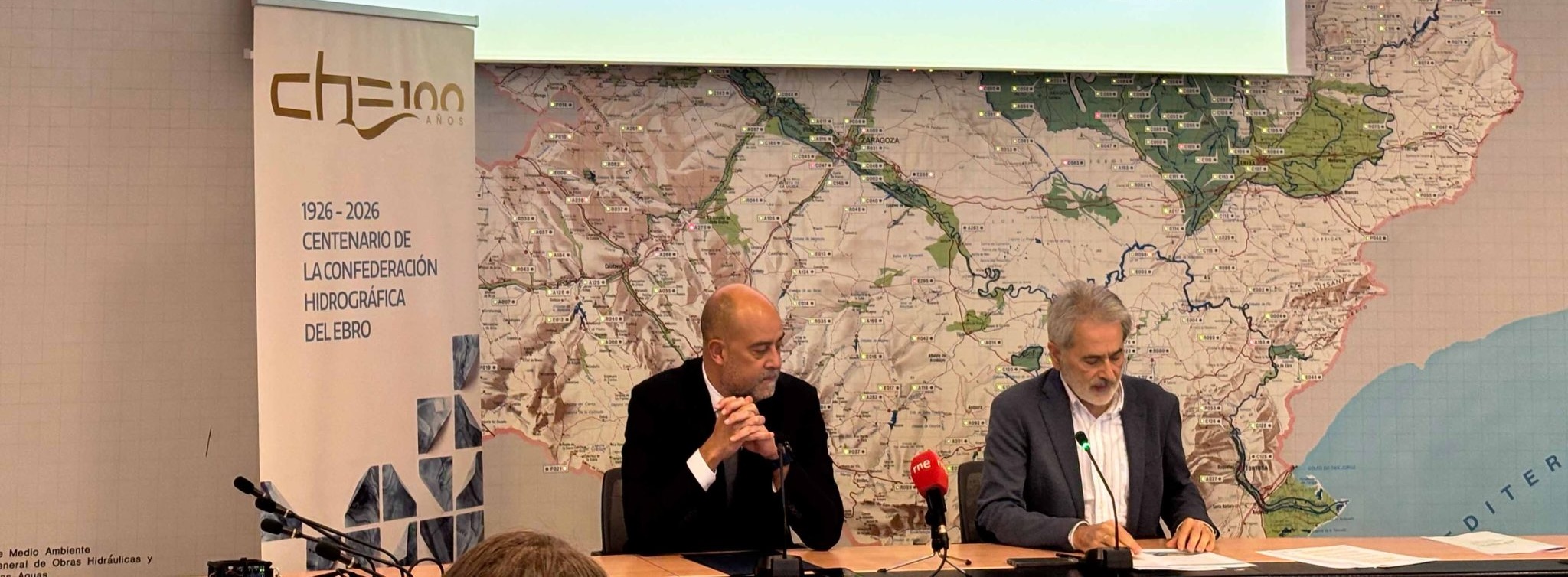
In 2026, one hundred years will have passed since the constitution of the organization: the first entity in the world created to manage water from the principle of basin unity, which has shaped a model worldwide.
2/12/2025
The Confederación Hidrográfica del Ebro is marking its centenary with a programme that will run throughout 2026. Institutional events, exhibitions, a series of meetings focused on water and the territories of the basin, a commemorative book and a documentary will be held, among other initiatives.
Established on March 5, 1926, the Confederación was created to manage the water of the Ebro basin as a whole, without borders between territories. One hundred years later, its centenary essence will travel through that same basin, from its source in the lands of Fontibre to its mouth in the Baix Ebre.
The centenary exhibitions will visit nine venues along the Ebro basin: Reinosa, Miranda de Ebro, Logroño, Vitoria-Gasteiz, Pamplona, Lleida, Huesca, Zaragoza and Tortosa. The first will be inaugurated on December 17, 2025 in Reinosa, in the exhibition hall of La Casona.
The exhibition route begins with the landscape of the Ebro and the natural environment that shapes the basin. It continues with the history of the Confederación and its adaptation to the changes of each era. Once located in time and territory, the exhibition shows how the water shared by the different territories of the Ebro is planned and cared for.
In addition, it delves into the heritage of the CHE and the culture generated around the river: the memory, the trades and the life of its inhabitants. The tour concludes with its own space in each venue, which links the exhibition with its surroundings. The contents include models, objects, documents, photographs and historical films, audiovisuals and games, which invite you to explore a century of living history.
All the information is available on the CHE centenary page, which functions as a digital connection space. There you can consult the agenda of activities, download graphic and audiovisual resources, and subscribe to the newsletter to follow the news of the program.
The current Confederación Hidrográfica del Ebro was founded under the name Confederación Sindical Hidrográfica del Ebro in March 1926. This milestone marked the beginning of the technical, modern management of a river basin. The Royal Decree that formalised its existence was published one day later, on 6 March 1926, in the Gaceta de Madrid.
The creation of the Confederation is credited to the engineer Manuel Lorenzo Pardo, who promoted the idea of managing water in an integrated way, considering the territory as a whole rather than administrative boundaries. His approach reflected the regenerationist spirit of the time: linking the use of water resources with the economic and social development of the regions.
The first projects of the Confederación. Today, professionals and entities from different places continue to visit the Confederación to learn first-hand about this management system and adapt it to their own contexts.
Over the course of a century, the Confederación has evolved along with technological advances and the social and environmental changes in the country. Today, its work combines the management of the public water domain with the protection of ecosystems, the mitigation of risks due to extreme events (floods and droughts) in a context of climate change and the promotion of sustainable water use.
About the CHE
The Confederación Hidrográfica del Ebro is an inter-regional river basin authority, attached to the Ministerio para la Transición Ecológica y el Reto Demográfico. Its functions include hydrological planning, the administration of the public water domain, and coordination with sectors linked to its various uses and with administrations, with the aim of guaranteeing sustainable management in the Ebro basin, the largest in Spain. Desde su creación ha trabajado para equilibrar la gestión técnica con la protección ambiental y el interés público con el diálogo territorial.