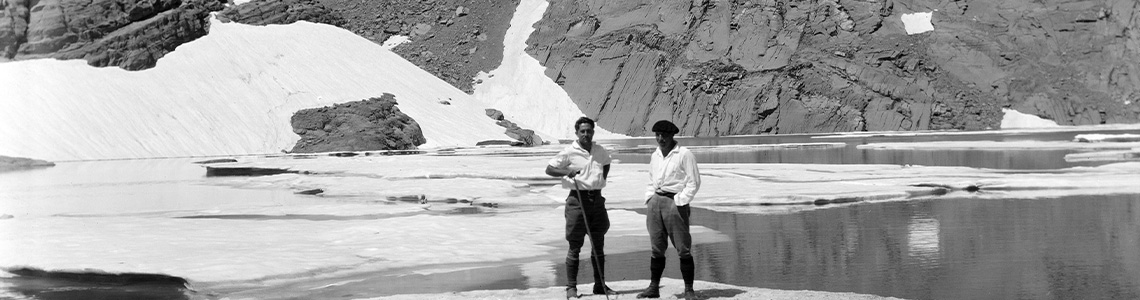
The Confederación Hidrográfica del Ebro (CHE) brings to Huesca, from November 3 to 28, the traveling exhibition Por la cuenca del Ebro. Centenario de la Confederación Hidrográfica del Ebro, which reviews the organization’s one hundred years of history and its work in water management in the Ebro basin.
The inauguration will feature interventions by Javier San Román Saldaña, Deputy Water Commissioner of the Confederación Hidrográfica del Ebro and Centenary Commissioner, and Sonia Latre Otal, Delegate Councilor for the Service of Culture, Cultural Heritage, and Institutional Relations of the Huesca City Council. Following the interventions, a guided tour of the exhibition will take place.
The exhibition route presents the natural, territorial, historical, and cultural diversity of the Ebro basin, as well as the evolution of its management over a century. It combines historical documentation, hydraulic heritage, photographs, models, and audiovisual and interactive content.
Huesca and the Riegos del Alto Aragón
In Huesca, the exhibition reflects the province’s historical relationship with water management and the importance of the Riegos del Alto Aragón in agricultural and territorial transformation. Through photographs, maps, and historical documents, it presents infrastructures such as the Mediano, El Grado, and La Sotonera reservoirs, as well as the role of the Vadiello reservoir in the water supply for the city of Huesca.
Among the highlighted pieces is a historical model of the Arguis dam, made in 1920, belonging to the CHE heritage collection. Built at a 1:100 scale and restored in 2022, it reproduces the original configuration of the dam, prior to the heightening works of 1930.
The exhibition also incorporates eight reproductions of the dioramas created by the Aragonese painter Ángel Díaz Domínguez for the Confederation’s pavilion at the 1929 Barcelona International Exposition. The images represent different infrastructures and landscapes linked to water, such as the Monegros canal, the Arguis reservoir, and the Devil’s Bridge in Olvena.
These materials are accompanied by publications on the history of irrigation, reservoirs, and the landscape of Alto Aragón from the CHE Archive, including 1913-2013. El siglo de la Peña. Historia de un pantano centenario en el río Gállego.
One hundred years of management of the Ebro basin
Beyond the contents related to Huesca, Por la cuenca del Ebro offers a global vision of the most extensive river basin in the State, articulated around the Ebro and its tributaries. The exhibition reviews the evolution of water management during the CHE’s hundred years of life and presents the documentary, technical, architectural, and artistic heritage generated during this period.
The exhibition also incorporates resources to bring current issues related to water and territory management closer to the public, as well as a summarized version, 12 minutes and 48 seconds long, of the Centenary documentary Por la cuenca del Ebro, produced in 2025 by Al Este Films and Virtual&Civán. Alongside it, a historical film of Mediano from 1936, five minutes in length, from the CHE archive, is projected.
The programming linked to the exhibition also includes the Centenary Encounters, which will be held on November 12, at 6:00 PM, at the Manuel Benito Moliner Cultural Center. This cycle of open conversations brings different perspectives on the history of the Ebro basin, water management, landscape, heritage, and environmental challenges to the public. Admission is free until full capacity is reached.
With this stop in Huesca, the exhibition Por la cuenca del Ebro continues its commemorative journey through the territory and invites visitors to learn about the history of the Confederación Hidrográfica del Ebro through the relationship between water, heritage, and the societies that have lived in the basin.
The exhibition may be visited in Nave II of the Manuel Benito Moliner Cultural Center, in Plaza Alcalde José Luis Rubió, from November 3 to 28, 2026.
Visiting hours:
-
Monday to Friday: from 6:00 PM to 9:00 PM.
-
Saturdays, Sundays, and holidays: from 12:00 PM to 2:00 PM and from 6:00 PM to 9:00 PM.
About the CHE
The Confederación Hidrográfica del Ebro (CHE) is an inter-community basin agency attached to the Ministry for Ecological Transition and the Demographic Challenge. Among its functions are the construction and maintenance of infrastructures (dams and canals), maintenance and management of the agency’s heritage, hydrological planning, administration of the public hydraulic domain, and coordination with sectors linked to its different uses and with administrations, with the objective of guaranteeing sustainable management in the Ebro basin, the largest in Spain. Since its creation, it has worked to balance technical management with environmental protection and public interest with territorial dialogue.
About the Centenary
The Confederación Hidrográfica del Ebro (CHE) was born under the name of Confederación Sindical Hidrográfica del Ebro, created on March 5, 1926, and made official the following day in the Gaceta de Madrid. That project, in which engineer Manuel Lorenzo Pardo played a decisive role, introduced in Spain the idea of managing water under the principle of basin unity, overcoming administrative limits and opting for comprehensive planning. A century later, its centenary offers the opportunity to revisit that origin and bring citizens closer to the evolution of water management in the Ebro. The commemorative program invites people to learn about this legacy and participate in it.