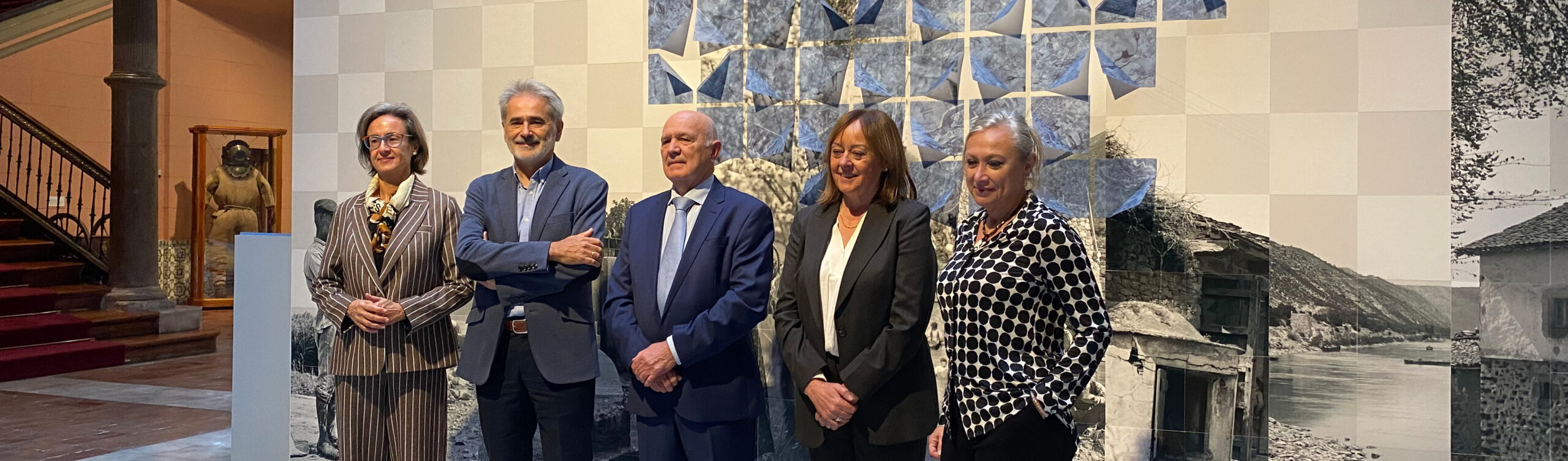
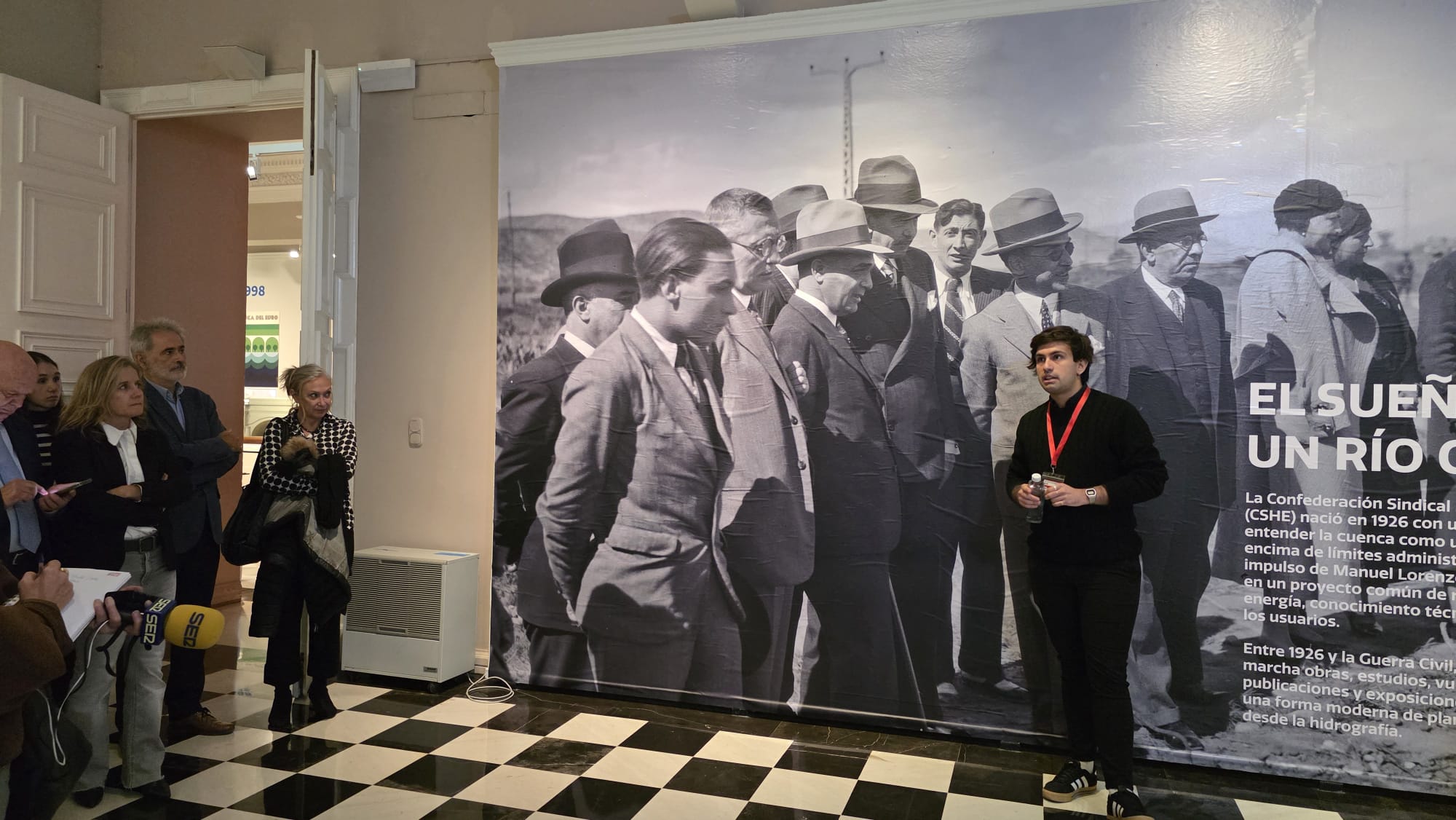
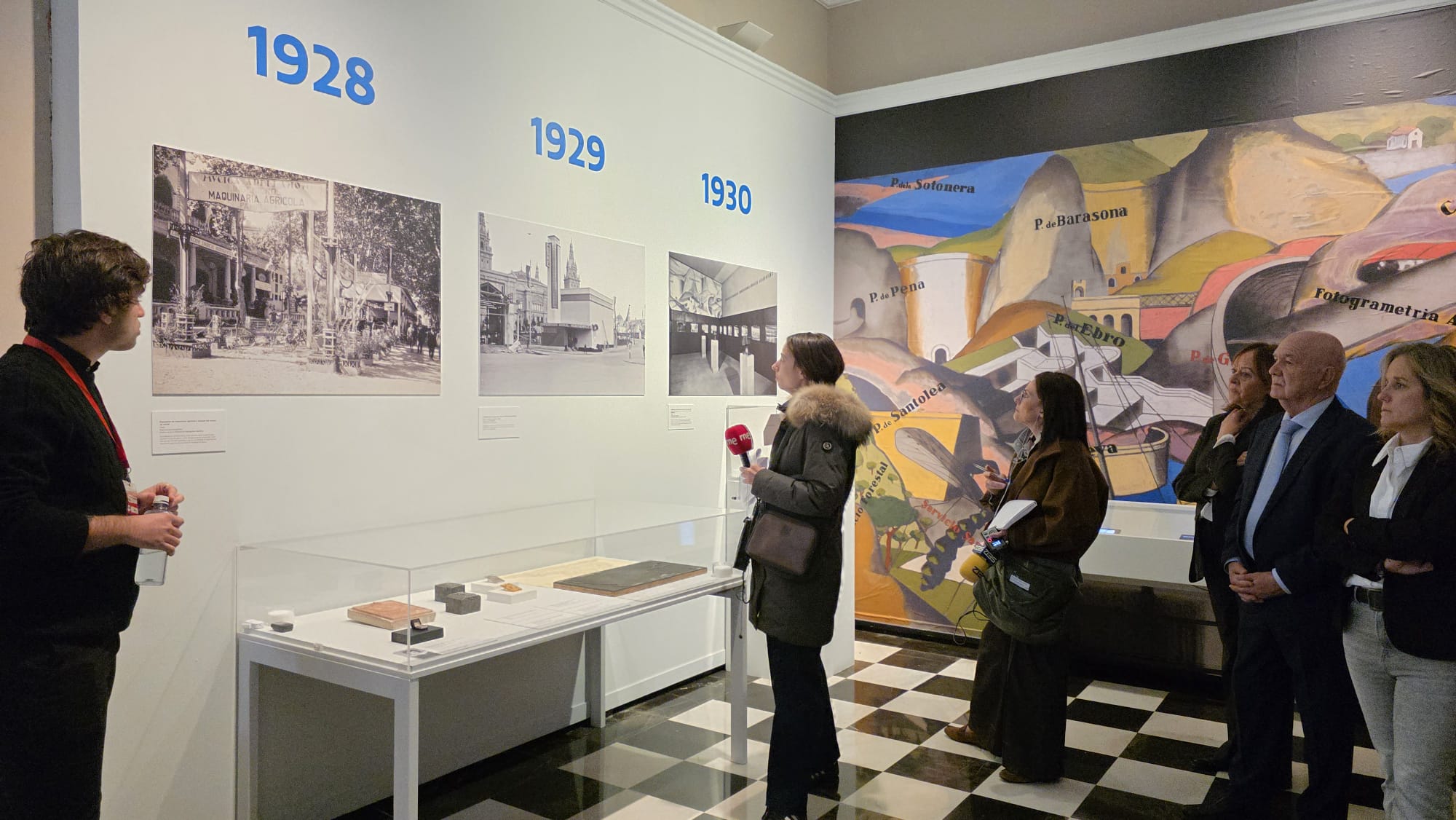
November 4, 2026.- The Deputy Water Commissioner of the Confederación Hidrográfica del Ebro (CHE), an agency under the Ministry for Ecological Transition and the Demographic Challenge, Javier San Román, has inaugurated the exhibition “Por la cuenca del Ebro”, organized on the occasion of the institution’s centenary (1926-2026). He was accompanied at the event by Francisco Compés, Deputy of the Provincial Council of Zaragoza.
During his address, San Román emphasized that the Centenary represents, above all, the celebration of an idea promoted by Manuel Lorenzo Pardo, an engineer linked to the Aragonese town of Gelsa, who defended the need to manage water resources under the principle of basin unity. This approach made it possible to establish a joint water management model to prevent conflicts between territories and guarantee water availability.
The Deputy Commissioner explained that this principle remains fundamental to the Confederación’s activity. Thus, the regulation of reservoirs contributes to reducing damage caused by floods and ensuring priority uses during drought periods, especially water supply. Likewise, the authorization of discharges and the granting of water use concessions must take into account the protection of rivers and the needs of users located downstream.
The exhibition offers a journey through the main events that have marked these one hundred years of history. Among them, San Román recalled the completion of the first photogrammetric flight in 1927, which made it possible to have more precise cartography for planning hydraulic infrastructures. He also noted the importance of reforestation works carried out to combat erosion and prevent the accumulation of sediments in reservoirs, thus favoring their long-term conservation.
Another highlighted aspect was the transformation of agricultural areas through the implementation of irrigation, a process that required adapting the land and led numerous rain-fed farmers to incorporate new cultivation techniques.
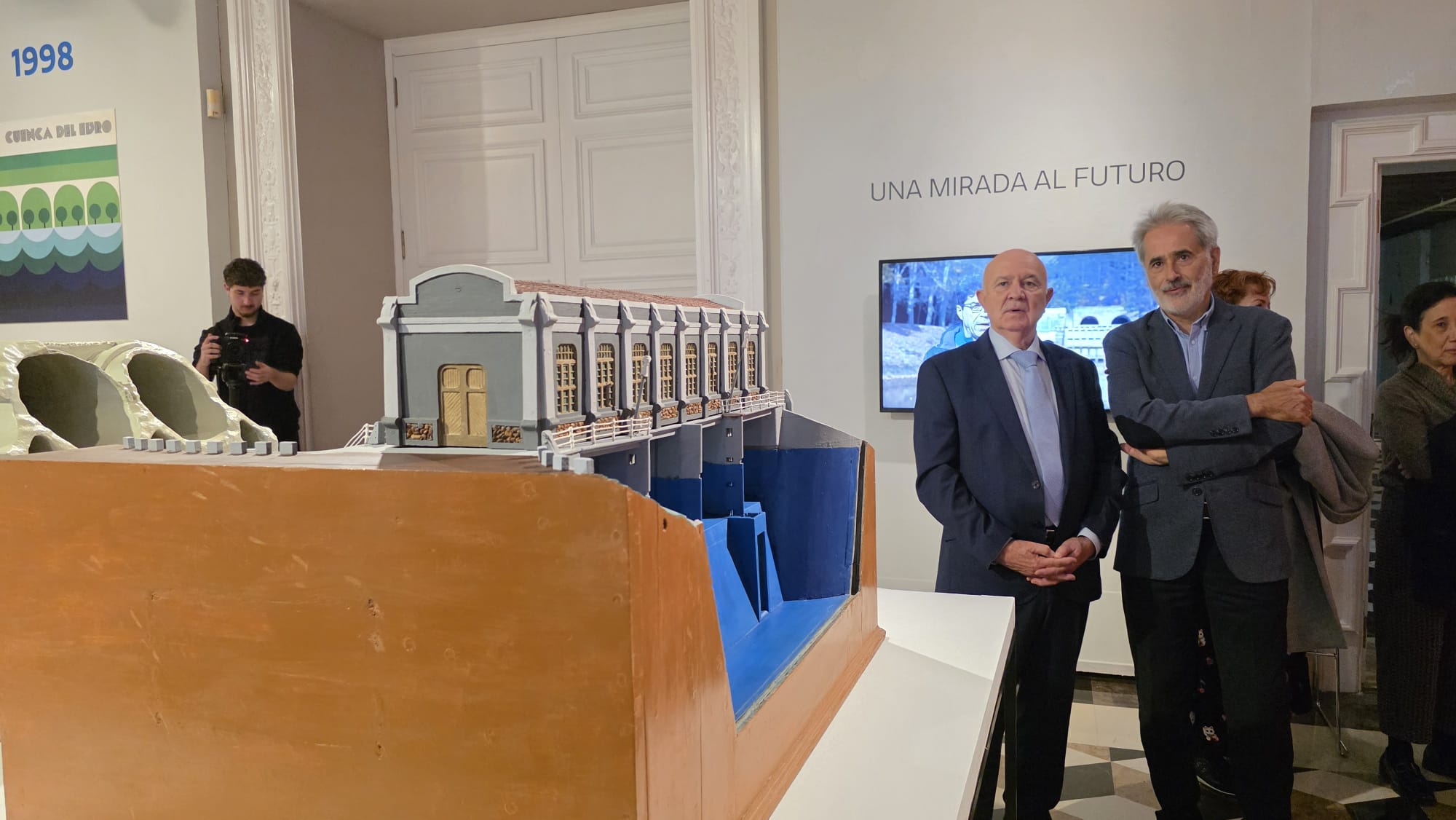
Among the contents of the exhibition, the historical films recovered from the 1920s acquire special prominence, allowing visitors to learn about the first agricultural fairs and different works related to the construction of hydraulic infrastructures, such as the Mediano reservoir. The tour is completed with models of reservoirs and other works linked to water management.
In addition to reviewing its historical trajectory, the exhibition brings visitors closer to the current reality of the Confederación Hidrográfica del Ebro and the technological tools it uses in its daily activity, such as the Automatic Hydrological Information System (SAIH Ebro).
About the CHE
The Confederación Hidrográfica del Ebro (CHE) is an inter-community basin agency attached to the Ministry for Ecological Transition and the Demographic Challenge. Among its functions are the construction and maintenance of infrastructures (dams and canals), maintenance and management of the agency’s heritage, hydrological planning, administration of the public hydraulic domain, and coordination with sectors linked to its different uses and with administrations, with the objective of guaranteeing sustainable management in the Ebro basin, the largest in Spain. Since its creation, it has worked to balance technical management with environmental protection and public interest with territorial dialogue.
About the Centenary
The Confederación Hidrográfica del Ebro (CHE) was born under the name of Confederación Sindical Hidrográfica del Ebro, created on March 5, 1926, and made official the following day in the Gaceta de Madrid. That project, in which engineer Manuel Lorenzo Pardo played a decisive role, introduced in Spain the idea of managing water under the principle of basin unity, overcoming administrative limits and opting for comprehensive planning. A century later, its centenary offers the opportunity to revisit that origin and bring citizens closer to the evolution of water management in the Ebro. The commemorative program invites people to learn about this legacy and participate in it.