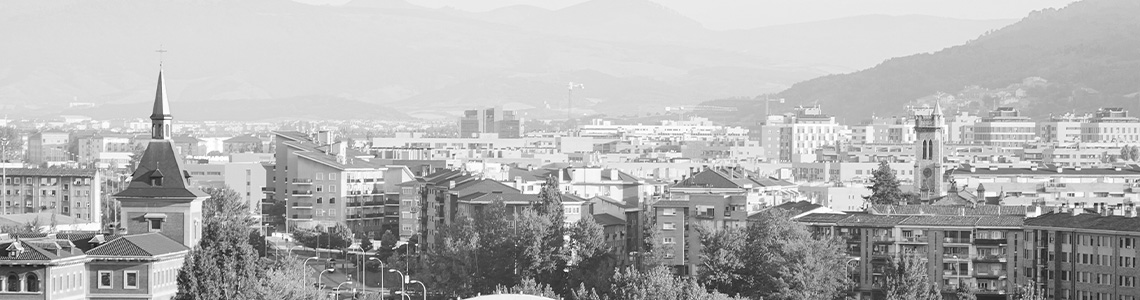
This afternoon at 7:00 PM, in the Sala Gótica of the Palacio del Condestable in Pamplona, the CHE inaugurated its centennial traveling exhibition, Por la cuenca del Ebro. The event included a guided tour open to the public.
The event featured speeches by Joxe Abaurrea San Juan, second deputy mayor and councillor for Strategic Government, Urban Planning, Housing, and Agenda 2030 for the Pamplona City Council, who delivered a welcoming address on behalf of the municipality, followed by a speech from the Minister of Territorial Cohesion of the Government of Navarra, Óscar Chivite, who alluded to the importance of water management in Navarra and the close relationship with the CHE. Subsequently, he introduced Javier San Román Saldaña, Deputy Water Commissioner of the Confederación Hidrográfica del Ebro and Centennial Commissioner. Following the speeches, the tour of the exhibition began.
The exhibition opened to the public today, July 23, and can be visited until August 30, 2026, in the Sala Gótica of the Palacio del Condestable.
Pamplona, crossed by the Arga River, along with the rest of the Navarrese tributaries, is a crucial enclave in the management of the Ebro basin. The Arga has shaped the urban configuration, the fertile lowlands, traditional water uses, and the evolution of the territory.
In Navarra, the Confederación Hidrográfica del Ebro manages, among others, the reservoirs of Alloz, Eugui, Yesa, Itoiz, Urdalur, and Mairaga.
The exhibition route reviews one hundred years of water management in the Ebro basin and combines historical documentation, hydraulic heritage and outreach content on the territory’s current challenges.
The exhibition invites visitors to explore the history of water management and to understand how cooperation between administrations, user communities, and citizens has contributed to organizing water use, reducing risks, and conserving the ecosystems linked to the rivers.
The programming linked to the Pamplona venue will conclude on July 30, at 6:00 PM, with a new session of the Centennial Encounters at the Palacio del Condestable.
The Centennial Encounters are a series of open conversations designed to bring the centennial of the Confederación Hidrográfica del Ebro closer to the territories and the public. At each venue, the session proposes looking at the river and its basin from different angles—history, water management, landscape, heritage, and environmental challenges—using an accessible and informative format.
In Pamplona, the session will be held under the title “Conversations on the Rivers of Navarra: Risk Reduction, Heritage, and Culture” and will address two issues particularly linked to the Navarra territory: adaptation to floods and the role of water as a cultural, heritage, and social connecting axis.
Participants will include Luis Sanz Azcárate, with the presentation “Floods in Navarra: From Control to Adaptation. Institutional Cooperation to Reduce Risk”, and José Antonio Perales Díaz, with the talk “Connecting Cultures: Bridges and Mills of Navarra”.
About the CHE
The Confederación Hidrográfica del Ebro (CHE) is an inter-regional river basin authority, attached to the Ministerio para la Transición Ecológica y el Reto Demográfico. Its functions include the construction and maintenance of infrastructure, such as dams and canals; the maintenance and management of the authority’s assets; hydrological planning; administration of the public water domain; and coordination with sectors linked to its various uses and with public administrations. Its aim is to ensure sustainable management in the Ebro basin, the largest in Spain. Since its creation, it has worked to balance technical management, environmental protection, the public interest and territorial dialogue.
About the Centenary
The Confederación Hidrográfica del Ebro (CHE) was founded under the name Confederación Sindical Hidrográfica del Ebro, created on March 5, 1926 and made official the following day in the Gaceta de Madrid. That project, in which engineer Manuel Lorenzo Pardo played a decisive role, introduced in Spain the idea of managing water under the principle of basin unity, overcoming administrative boundaries and committing to comprehensive planning. A century later, its centenary offers an opportunity to revisit those origins and bring the evolution of water management in the Ebro closer to the public. The commemorative programme invites people to discover this legacy and take part in it.